As anticipation builds for the 2026 FIFA World Cup set to unfold across Canada, Mexico, and the United States, football enthusiasts are eager to uncover which of the 48 participating teams will rise above the competition. While definitive predictions are elusive, researchers have harnessed machine learning to construct probabilistic forecasts for every potential match, simulating the tournament's progression through data-driven analytics.
Team Strengths and Prediction Models
The forecasting methodology integrates historical performance data, betting odds, and player evaluations through a sophisticated blend of statistical models. By analyzing past matches dating back to 2006 and employing insights from 24 bookmakers, the model generates an evaluation of each team's capability. Key metrics include player ratings based on club performances and market value estimates reflecting collective player worth.
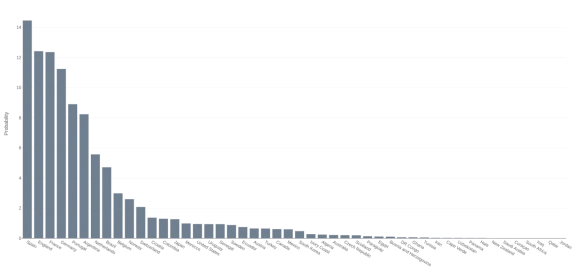
The resulting predictions indicate that Spain emerges as a frontrunner with a 14.5% probability of winning, followed closely by England (12.4%), France (12.4%), and Germany (11.2%). The algorithm establishes these figures by simulating match outcomes across a myriad of scenarios, allowing for nuanced insights into how teams might fare in the tournament.
Interactive full-width graphic
Data Sources and Hybrid Modeling
The forecasting combines two principal stages: first, the use of expert evaluations alongside statistical models to derive team and player strengths; second, a machine learning algorithm that synthesizes these strengths with additional information about teams. Various data streams inform this process:
-
Historic Match Data:
By utilizing a bivariate Poisson model, the algorithm processes match outcomes over the past eight years to establish weighted estimates of current team strengths, giving greater emphasis to more recent performances. -
Bookmaker Odds:
Consensus abilities are derived from betting odds adjusted for profit margins to paint a realistic picture of team strengths as perceived by industry experts. -
Player Contributions:
Individual player performance ratings, tracked through their involvement in matches, are aggregated to produce average team ratings reflecting overall player contributions. -
Market Valuations:
Using a crowd-sourced model from Transfermarkt, estimated player market values encapsulate their perceived worth, further enriching the predictive framework. -
Machine Learning Integration:
An ensemble learning approach involving hybrid random forests merges these disparate data sources, bolstering the accuracy of forecasts by leveraging a variety of informative features.
Match Outcome Simulations
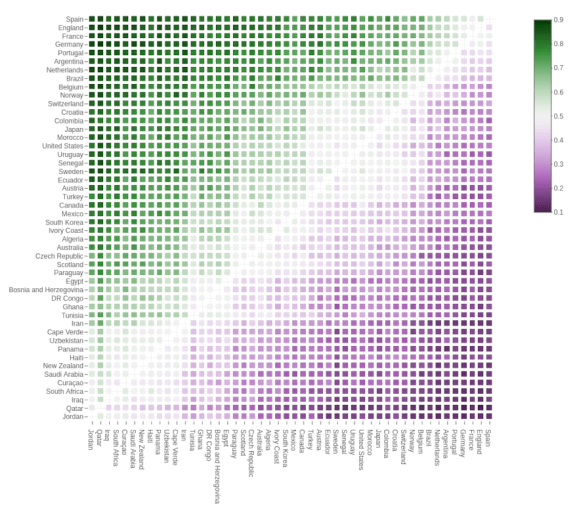
To predict match outcomes, the model calculates expected goals for each team in potential encounters, informed by the differences across key player and team characteristics. By applying independent Poisson distributions, the model can then compute probabilities for wins, losses, and draws.
The interaction tool demonstrates the predicted matchup outcomes across the knockout rounds, offering a color-coded heatmap for quick reference on team performances against each other.
Interactive full-width graphic
Comprehensive Tournament Simulations
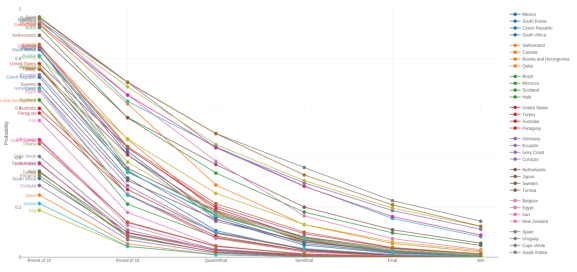
The model also allows for extensive simulation of the entire tournament, providing insights into each team's survival probabilities through the various stages. By simulating each match outcome across 100,000 iterations, the model portrays the likelihood of teams advancing through the groups and knockout rounds.
Interactive full-width graphic
Understanding Uncertainties in Predictions
While these forecasts provide intriguing insights, the outcomes remain probabilistic and reflect inherent uncertainties in any sporting event. The 2026 World Cup is characterized by a larger field of teams and various tournament permutations, leading to a broader distribution of potential outcomes.
Interestingly, comparisons against bookmaker predictions reveal some discrepancies; for example, Germany's success probability is projected to be higher despite bookmakers placing them lower. This detail underscores the complexity of predicting outcomes in a sport defined by unpredictability.
Ultimately, while the forecasts suggest various potential paths to victory, one thrilling aspect of the upcoming World Cup is the anticipation of unexpected results that can emerge as matches unfold. As football fans, the engaging nature of the game promises an exhilarating tournament experience—one that goes beyond mere statistical prediction.
R-bloggers.com offers daily e-mail updates about R news and tutorials about learning R and many other topics. Click here if you're looking to post or find an R/data-science job.
Want to share your content on R-bloggers? click here if you have a blog, or here if you don't.