The push for identity-centric security in enterprises necessitates efficient management of identities and access across diverse platforms. In this context, the System for Cross-domain Identity Management (SCIM) offers a standardized approach to identity lifecycle management that simplifies user and group provisioning in HashiCorp Vault. By aligning provisioning processes with existing authoritative identity providers, organizations can minimize configuration drift, securely enforce workflows for joiners, movers, and leavers, and enhance governance of their identity systems.
In high-stakes environments, where access to secrets needs to be tightly controlled and auditable, SCIM facilitates an identity-first security framework within Vault. This reduces compliance risks linked to outdated or orphaned access, thereby fortifying overall security postures.
Leveraging SCIM for Scalable Identity Management
SCIM support in IBM Vault Enterprise and HCP Vault Dedicated (currently in beta) addresses a significant gap for teams tasked with managing extensive identity and credential access. This new capability allows for a standardized connection between identity lifecycle workflows and Vault, streamlining the management of user identities in line with existing organizational processes.
Adopting SCIM enables teams to implement a consistent provisioning paradigm across their identity resources within Vault. This beta version currently supports popular SCIM clients like SailPoint and Okta, with plans to extend this compatibility in future iterations.
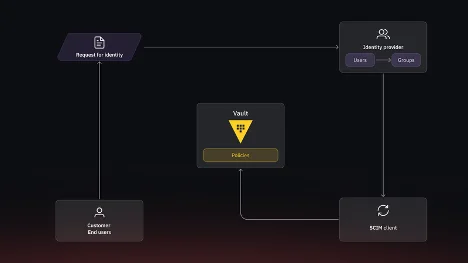
SCIM Configuration in Vault
With the new beta release, Vault exposes SCIM through its identity secrets engine. This integration maps SCIM users to specific Vault entities and SCIM groups to internal identity groups, allowing each SCIM client to manage only the users and groups it has created. However, it’s essential to note that SCIM governs identity objects without extending to Vault policies.
Focused and Secure Provisioning
Every SCIM client established in Vault represents a unique external provisioning system. Configurations for these clients include:
client_name
access_grant_principal
alias_mount_accessor
This authentication model adheres to Vault's identity primitives, enabling secure access through supported auth methods and aligning provisioning workflows with specific paths via the alias mount accessor. This structure delineates a clear trust boundary, ensuring that external systems only manage resources tied to their SCIM client.
Key Features of SCIM Beta
The SCIM beta, available to Vault Enterprise and Vault Dedicated customers, incorporates significant functionalities, including:
Configuration of SCIM client through /identity/scim/client
Operations for user: create, read, list, replace, patch, delete
Operations for group: create, read, list, replace, patch, delete
Discovery endpoints for Schemas, Resource Types, and Service Provider Config
Responses from Vault utilize the application/scim+json format, simplifying integration with other SCIM clients. Customers running Vault version 2.0.1 or later can activate this functionality directly from the user interface, with further instructions available in the Vault developer documentation.
Enhanced Lifecycle Management for Users and Groups
SCIM's standardized approach to provisioning ensures that user and group management in Vault adheres to the principle of least privilege. With this implementation, external clients can dictate permissions via SCIM group memberships, while Vault retains authority over the relevant policies. This not only streamlines access management but also mitigates risks associated with excessive or outdated privileges.
Vault functions as the authoritative source, mirroring SCIM groups and memberships to maintain accurate identity-based access to secrets. This integration significantly reduces the discrepancies between identity systems and Vault entities, minimizing the potential for human error and access mismanagement.
Embarking on SCIM Integration
The SCIM feature for Vault equips platform, security, and identity teams with a powerful method for standardized user and group provisioning. Rather than relying on manual processes or bespoke integrations, organizations can seamlessly connect Vault with their existing identity lifecycle systems.
For those seeking to simplify identity provisioning while diminishing operational overhead, evaluating SCIM for Vault during its beta phase is advisable. Begin by establishing a dedicated SCIM client, test your provisioning platform's compatibility with Vault's operations, and strategize on token lifecycle and authentication methods early on.
Modern platforms require streamlined identity provisioning to enhance operational efficiency and reduce friction. With SCIM support rolling out in Vault Enterprise (beta starting April 30, 2026) and Vault Dedicated (beta starting June 15, 2025), organizations can capitalize on these advantages to improve their security and management efficiency.
For more comprehensive details on activating SCIM and provisioning identity users and groups, consult the Vault developer documentation.