Data visualization plays a pivotal role in analysis, and one of the best tools for this in Python is Matplotlib. The function plt.scatter() from the pyplot module allows you to create both basic and advanced scatter plots that can illustrate complex relationships between variables. It offers extensive customization options, making it an invaluable asset for data scientists and analysts alike.
Why Data Visualization Matters
Understanding data is not merely about numbers; it's about conveying complex relationships in a visually intuitive way. Data visualization bridges this gap, enabling analysts to spot trends and anomalies that might remain hidden within raw data. A well-constructed scatter plot, for instance, can reveal correlations and patterns that inform critical business decisions. This becomes even more important as the amount of data generated continues to grow. You'll find that the ability to visualize data effectively can make the difference between insight and confusion.
Key Takeaways
- Creating a scatter plot involves invoking
plt.scatter()with two array-like inputs representing the x and y coordinates. - Marker properties such as size, color, shape, and transparency can be modified using the
s,c,marker, andalphaparameters, allowing for detailed representation. - While
plt.scatter()offers extensive customization per data point,plt.plot()is more efficient for straightforward plots. - You can encode multiple dimensions in a single scatter plot by varying marker attributes.
- Matplotlib offers various plot styles, which you can explore via
plt.style.available, enhancing your visualizations.
Preparing to Use plt.scatter()
To make the most of this tutorial, familiarity with Python fundamentals and some knowledge of NumPy would be helpful. You don't need prior experience with Matplotlib, but for those interested, resources like Python Plotting With Matplotlib (Guide) are available. This mixture of knowledge can significantly enhance your ability to manipulate and experiment with data visualizations.
Get Your Code: Download free sample code for creating custom scatter plots using plt.scatter().
Test Your Knowledge: Take our interactive quiz on creating scatter plots in Python—track your progress and sharpen your skills:

Interactive Quiz
Creating Scatter Plots in Python with plt.scatter()Practice using plt.scatter() to create scatter plots and represent multiple variables.
Creating a Scatter Plot in Python
A scatter plot visualizes the relationship between two variables, allowing you to identify patterns or correlations. This segment introduces the creation of basic scatter plots using Matplotlib, followed by advanced techniques for representing complex data. Understanding how to correctly interpret a scatter plot involves more than just creating one. The insights drawn from the data can drive significant strategic decisions.
Using plt.scatter()
First, ensure Matplotlib is installed. You can do so with Python’s package manager pip by running:
$ python -m pip install matplotlib
With Matplotlib set up, consider this practical scenario: a café owner tracks daily sales of various orange drinks priced differently. To analyze this relationship, visualize the data:
import matplotlib.pyplot as plt
price = [2.50, 1.23, 4.02, 3.25, 5.00, 4.40]
sales_per_day = [34, 62, 49, 22, 13, 19]
plt.scatter(price, sales_per_day)
plt.show()
This Python script shows how to import Matplotlib’s pyplot as plt—a common convention for brevity. You then define lists with prices and corresponding daily sales for each type of drink. Here’s the crux: a scatter plot is generated using plt.scatter() with the two variables provided as arguments. You must display the plot using plt.show() when running a script. In interactive environments like Jupyter Notebooks, the plt.show() call is typically optional, but including it can help clarify the script's intention.
The following output represents your data visually:
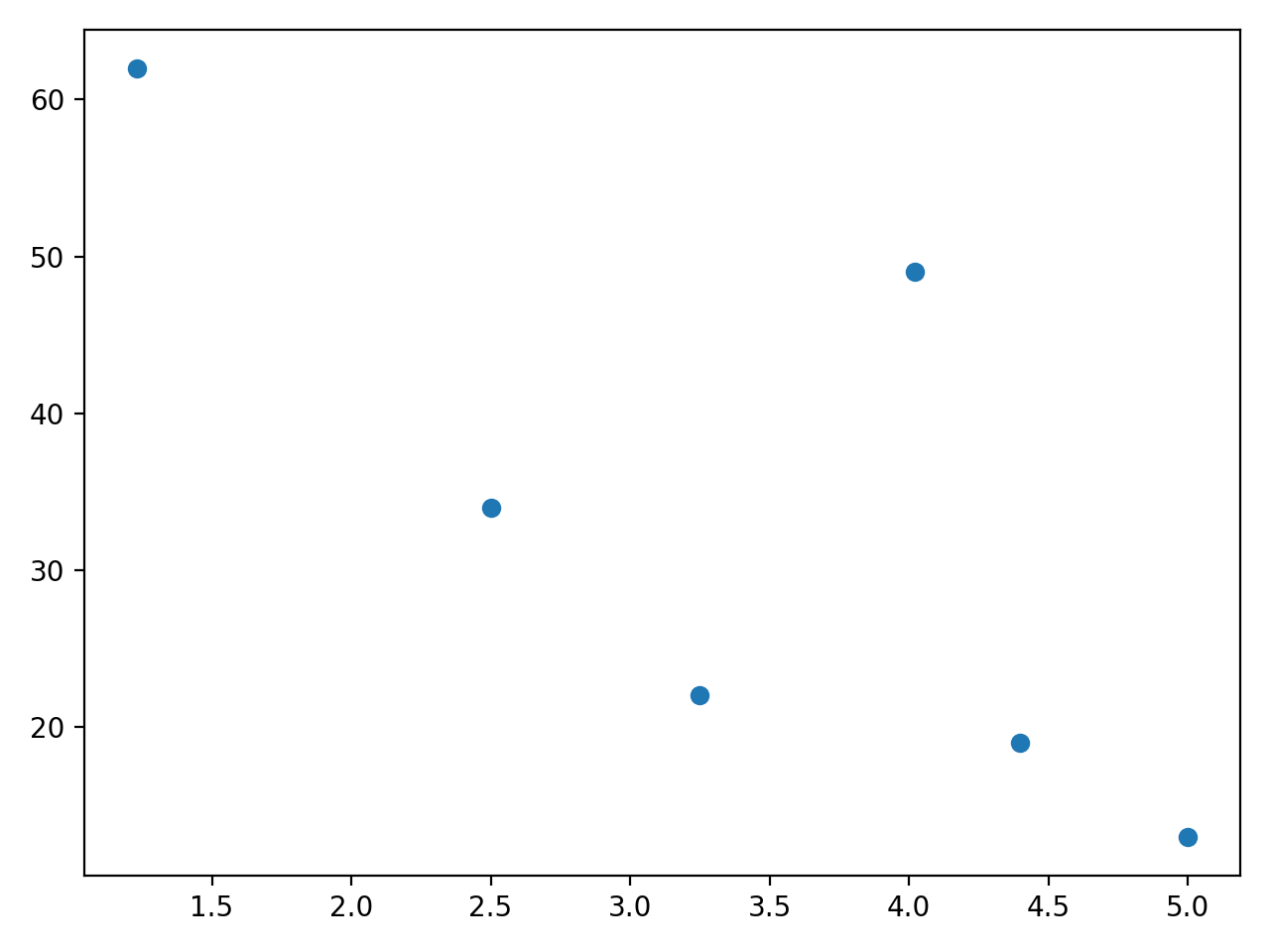
This plot reveals an inverse relationship where generally, as price increases, sales decrease—except for a noteworthy outlier at $4.02. This output invites further examination; despite its simplicity, the scatter plot can prompt deeper analyses using methodologies like linear regression. By uncovering these relationships, you provide actionable insights that are often necessary for informed decision-making.
Comparing plt.scatter() and plt.plot()
It's also possible to create a similar scatter plot using plt.plot(), Matplotlib's more versatile function for generating various plot types. However, the nuance lies in the details. To replicate the earlier scatter plot, specific steps must be followed. To do this, incorporate the marker argument, ensuring it displays as desired:
plt.plot(price, sales_per_day, "o")
plt.show()
In this scenario, adding the marker "o" as a third argument is necessary to avoid generating a line graph, leading to a misrepresentation of the data. This highlights a fundamental point: while both functions can yield scatter-like visualizations, plt.scatter() is arguably more straightforward for that specific purpose. Understanding these distinctions can enhance how you visualize and analyze data.
Future Implications of Advanced Visualization Techniques
The growing significance of data visualization drives its evolution. As complexity in data increases, tools that simplify nuanced connections will gain traction. Tools like Matplotlib not only provide ways to visualize data but also encourage analysts to adopt flexible, multifaceted approaches. If you're working in this space, keeping up with these developments can enhance your skill set, ensuring that you're not just a consumer of data but a proficient interpreter of it.
In an age where data underpins decision-making across sectors, mastering visualization tools becomes not just advantageous but essential. And perhaps that’s the most compelling argument for investing time in learning how to use them effectively.