In June 2026, the Insikt Group identified 59 vulnerabilities deemed critical for immediate remediation, with 30 classified as very critical according to the Recorded Future Risk Score. This marks a striking 47% increase from the previous month—a sharp escalation that raises alarms in cybersecurity circles. Notably, 23 of these vulnerabilities appeared in the U.S. Cybersecurity and Infrastructure Security Agency (CISA’s) Known Exploited Vulnerabilities (KEV) catalog, while 33 were reported through vendor channels. The remaining three were primarily uncovered via honeypot data. This level of vulnerability underscores persistent challenges in systems security management across sectors.
Vulnerabilities Across Diverse Products
This month’s findings reveal vulnerabilities impacting an extensive array of products from 36 different vendors. Crucially, Microsoft alone accounted for about 17% of the reported vulnerabilities. This concentration is concerning because a significant number of enterprises rely on Microsoft solutions, meaning that exploits associated with these products can have widespread ramifications. The exposure extends beyond just Microsoft; it includes various sectors such as enterprise software, security products, cloud platforms, and network infrastructure tools. These sectors becoming increasingly interconnected raises the stakes; a vulnerability in one area might cascade into vulnerabilities across the board.
Diving Deeper: Detection and Tools
The Insikt Group developed Nuclei templates targeting two vulnerabilities highlighted in this month's report: CVE-2026-35616 affecting Fortinet FortiClient EMS and CVE-2026-25939 linked to Frangoteam FUXA. These templates have been made accessible to Recorded Future customers via the Recorded Future Intelligence Operations Platform. This accessibility is significant; it empowers organizations to implement more effective defenses and respond promptly to emerging threats. Fast, efficient detection methods contribute to mitigating damage as they allow for quicker patching and remediation efforts.
Active Vulnerabilities: Snapshot from June 2026
Below is a table summarizing the 56 vulnerabilities actively exploited this month, excluding those linked to honeypot activities. The listed proofs of concept (PoCs) should be approached with verification caution for accuracy and efficacy.
Table 1: These vulnerabilities are based on data from Recorded Future for occurrences in June 2026, excluding honeypot CVEs.
Key Trends and Observations
- This month, 25 of the 59 vulnerabilities enabled remote code execution (RCE), affecting products from a range of 18 different vendors. The most frequently exploited flaws included CWE-22 (Path Traversal) and CWE-502 (Deserialization of Untrusted Data). The rate at which these vulnerabilities are exploited highlights that vendors need to take action—quickly.
- A concerning trend is the continued exploitation of vulnerabilities that are several years old. This clearly points to a persistent lag in patch management in various environments. Why aren’t organizations fixing these issues? Patching remains a challenge for organizations, often due to a mix of operational inertia and failed prioritization.
- Notably, the quickest time from public disclosure to actual exploitation was recorded under a day. This accentuates the urgency for proactive security measures, as attackers are continuously ready to pounce on newly publicized weaknesses.
Trend Analysis: Malware Exploitation and Intrusion Activities
June witnessed numerous exploitation campaigns targeting publicly accessible enterprise applications. The Insikt Group issued findings tied to the StrikeShark campaign, which leveraged vulnerabilities like CVE-2025-55182 related to React Server Components and CVE-2021-26855 impacting Microsoft Exchange. These exploits often led to the deployment of malicious tools such as SharkLoader to aid further penetration. Every new tool just makes the attacker’s life easier. Manufacturers should be worried.
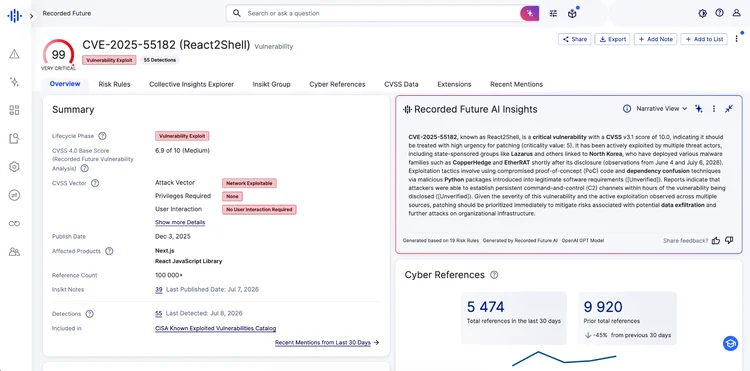
The attack landscape also showcased threats from groups like Lazarus, exploiting CVE-2025-55182 for targeted attacks on the financial sector. This particular focus is troubling; financial institutions are usually high-value targets due to their access to sensitive data and assets. Connections were also traced back to the exploitation of Microsoft systems by APT36, specifically targeting operations in India. Cybersecurity teams need to anticipate where threats will emerge next; ignoring these patterns is a risk they can’t afford.
The trends observed underscore a compelling need for vulnerability management teams to prioritize improvements in their patching processes and threat response strategies. Recorded Future clients can explore detailed analyses of this month's high-impact vulnerabilities and their associated exploits for a deeper understanding of the evolving threat dynamics. If you're working in this space, give special attention to these reports; they could be the difference between identifying a major risk and enduring a catastrophic breach.
Future Outlook: Preparing for Emerging Threats
As we look ahead, the implications of these findings could be significant. Vulnerability management can't take a backseat; organizations must be proactive in updating their security measures and educating their employees. Cultivating a culture of security is equally as crucial as technological upgrades. Businesses should also consider investing in ongoing threat intelligence to anticipate and respond to new exploits as they emerge. The cybersecurity arena is anything but static; organizations unwilling to adapt will find themselves increasingly vulnerable.
This turbulence isn't going away anytime soon. With evolving attack strategies and emerging technologies, security measures must evolve in tandem. The stakes are too high. As attackers refine their techniques and automate their processes, enterprises need to double down on their defenses. The message is clear: complacency isn’t an option.