Overview of TAG-195 Malware Families
Insikt Group's analysis has uncovered four distinct malware families within the TAG-195 ecosystem, also known as "Golden Chickens" or "Venom Spider." These new entries—TinyEgg, ChonkyChicken, a modularized version of ChonkyChicken, and ChromEggscalator—suggest an evolving approach to malware as a service (MaaS). TAG-195 is identified as a financially motivated provider of malware tooling, previously linked to operator TAG-127, showcasing its ongoing development and adaptation to current cyberspace operations.
This recent identification of four distinct malware families from TAG-195 emphasizes a significant trend in cybercrime. The development signals not just a creative evolution in malware design but also the evolving demands and tactics of cybercriminals. Many of these families appear to be categorized not just by their functionalities, but also by the complexity and depth of their capabilities, each serving specific roles within a larger strategy targeting security vulnerabilities.
Technical Insights and Capabilities
The introduction of these malware families points to a sophisticated architectural evolution. TinyEgg acts as a lightweight initial-access backdoor, enabling host profiling and interactive shell access, while ChonkyChicken expands its functionality to include browser credential theft and comprehensive remote execution capabilities. The modularized variant of ChonkyChicken implements a controller-and-plugin structure. This architecture allows the base implant to dynamically load at least 14 capability modules from remote servers, enhancing flexibility and reducing its static detection risk.
What's intriguing is how the modularity within ChonkyChicken might allow operators to tailor payloads based on their specific targets, thereby maximizing efficiency and operational effectiveness. Security systems typically rely on identifying known signatures or behaviors to capture malicious software, yet this modular design complicates traditional detection methods, making it a challenge for even the most sophisticated cybersecurity measures.
Additionally, the fourth family, ChromEggscalator, has been repurposed from a publicly available Chrome encryption-bypass tool, further illustrating TAG-195's adaptability. Collectively, these malware families exhibit shared characteristics such as consistent command-and-control mechanisms, a common persistence approach, and execution through a legitimate Windows utility. This use of trusted software as a delivery mechanism further clouds detection efforts, as threats masquerade under the guise of normal operations. Security measures that only examine behavior without contextual understanding of a system's normal functions can easily overlook this kind of threat.
Strategic Impact on Cybersecurity
With these developments, TAG-195’s modular architecture appears to lower the likelihood of detection while providing tailored capabilities for different operational demands. This shift likely reflects the commercial incentives of the MaaS model, allowing users to customize their toolkit based on specific intrusion requirements while minimizing the risk of exposure in case of compromise.
Security professionals should be particularly alert to potential attack vectors, such as clipboard execution frameworks mimicking legitimate system functionalities and unusual outbound traffic directed towards attacker-controlled infrastructure. And this is the part most people overlook: the ability of these threats to imitate normal user behavior makes them especially insidious. As the technology changes, so do the tactics used by malicious actors. The industry's response must be equally dynamic, utilizing advanced analytics and threat intelligence to catch anomalies that may signify an intrusion.
Contextual Background
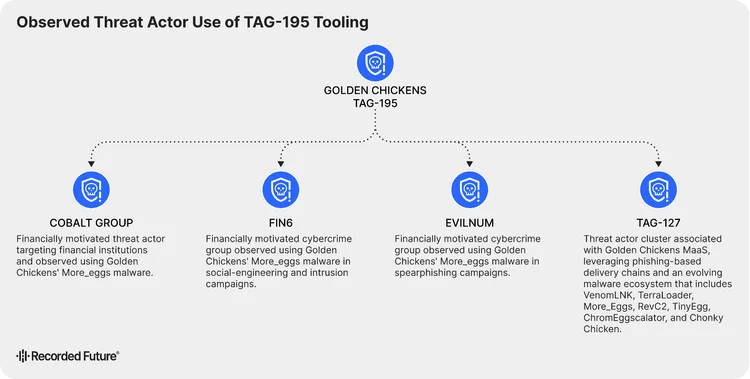
TAG-195 has established itself as a prevalent player within the MaaS domain, consistently providing tooling for credential theft and remote access. Its malware caters to various organized criminal groups, including known entities like FIN6, Cobalt Group, and Evilnum, illustrating its ongoing relevance in cybercrime. The established relationships between TAG-195 and threat actors signal a high level of operational maturity, although specifics surrounding its sales and distribution models remain elusive.
This environment fuels a staggering growth in the malware market, where accessibility and organizational partnerships permit even lower-skilled attackers to engage in cybercrime activities previously reserved for those with extensive technical know-how. Such accessibility raises ethical questions, as who bears responsibility when simple tools lead to complex crises. This new era of cybercrime indicates that merely addressing individual threats might not suffice anymore; a more holistic approach to cybersecurity is needed, one that takes into account the entire ecosystem of players involved.
Future Outlook: Risks and Responses
The emergence of TAG-195 and its sophisticated malware families poses significant challenges for cybersecurity professionals. As attackers adapt their strategies to exploit new vulnerabilities, defenders must continually refine their methodologies to anticipate these shifts. Detection capabilities will need to go beyond traditional signatures and heuristics.
Investing in behavioral analytics, threat intelligence sharing, and collaborative defense mechanisms will be essential. For those working in this space, staying informed about the latest tactics and technologies is paramount. Cybercriminals are not likely to slow down; if anything, the evolution of malware illustrates a commitment to developing tools that are harder to detect and easier to deploy.
What this means for you, whether you're a security professional or a business owner, is a need for vigilance and adaptability. The threat landscape will only grow more complex, demanding a proactive stance from all involved. This situation requires immediate action, as the stakes have never been higher.