Reimagining Cyber Defense
The integration of artificial intelligence (AI) with threat intelligence is reshaping how organizations approach cybersecurity. Rather than merely automating existing workflows, the true innovation lies in how AI enhances the understanding of both attacker behavior and internal vulnerabilities. This combination should narrow the traditional gap between attackers and defenders, allowing for a more proactive defense strategy.
The Challenge for Traditional Defenders
Cyber defenders face a well-established challenge: they must cover every potential attack surface, while attackers only need to exploit one vulnerability. Budget constraints and operational requirements often hinder defenders, placing them at a disadvantage. Traditionally, threat intelligence consisted of isolated data feeds, such as malware signatures and advisories, which were primarily reactive and often too generic to be immediately actionable.
Evolution Through Automation
Much of the current impact of AI within cybersecurity has been through automation—speeding up processes like alert analysis and patch prioritization. While these improvements enhance efficiency and relieve analyst workloads, they largely build upon existing methodologies rather than transforming them. Automation might optimize workflows, but the real breakthrough emerges from fusing AI with threat intelligence.
Intelligence Meets AI: A New Paradigm
The transformative potential arises from the convergence of AI and threat intelligence—particularly when both are used in real-time to assess and respond to threats. By analyzing attacker techniques (TTPs) alongside organizational vulnerabilities, AI systems can create a dynamic overview of risk, enabling quicker and more specific defenses.
Mapping Threats to Vulnerabilities
In the past, understanding how attacker techniques applied to an organization's infrastructure required extensive human effort, often hindering response times. AI can now continuously analyze threat reports, linking vulnerabilities directly to real-time assessments of an organization's environment. This automation allows for a rapid identification of risk levels, transforming threat intelligence from mere awareness into actionable defense strategies.
Integrating Dual Knowledge Sources
Defenders have routinely separated external threat intelligence from internal vulnerability data, resulting in a disjointed view of security posture. AI technology can merge these streams seamlessly, providing comprehensive insights into how external tactics intersect with internal exposures, providing defenders with insights that are both strategic and actionable.
Prioritizing Based on Real Threats
Traditional methods of patch prioritization rely heavily on theoretical severity scores, which fail to consider the contextual reality of active threats. AI can shift this approach by prioritizing vulnerabilities based on real-time exploitation data, enhancing accuracy in determining what needs immediate attention.
Enhanced Incident Response with Predictive Capabilities
During incidents, speed and foresight are vital. AI can leverage historical and contextual insights about known attacker behaviors to anticipate future actions. By predicting the next steps of adversaries, defenders can transition from reactive measures to proactive defenses that might intercept sophisticated attacks.
Deception Techniques Reinvented
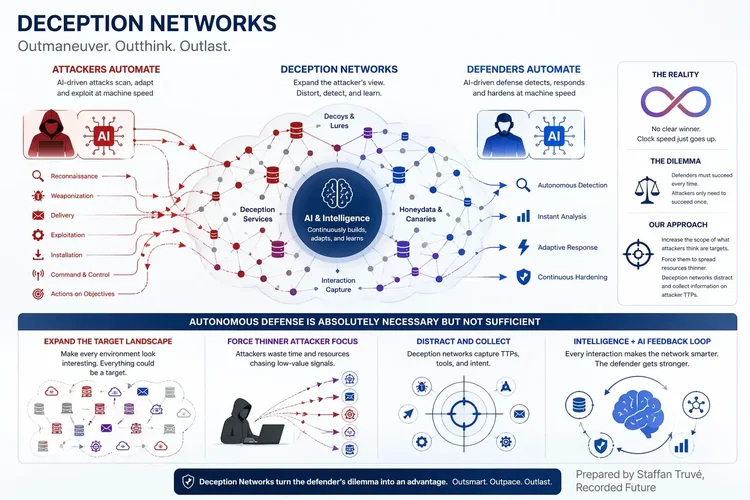
While traditional cybersecurity measures focus on detection and prevention, the synergy of AI and intelligence introduces opportunities for deception—a technique that can mislead attackers into exposing their methods. AI-generated deception strategies include dynamic honeypots and adaptive environments that can change in response to attacker behavior, making it increasingly difficult for adversaries to distinguish between real and fake assets.
Tailored Deceptive Environments
Historically, deceptive tactics relied on static setups that attackers could easily detect. The marriage of AI and threat intelligence allows for the real-time adjustment of deceptive layers, offering realistic decoy infrastructure that maintains its authenticity even under scrutiny. AI can position decoys along paths most likely to be exploited by specific adversaries, enhancing the effectiveness of deception.
Impact of AI-Generated Deception
With enhanced deceptive tactics in place, adversaries are forced to expend additional resources discerning real assets from traps, effectively reversing the traditional dynamics of the cybersecurity struggle. This shift demands that attackers verify every asset, while defenders need only to successfully deploy one convincingly placed decoy to thwart an attack.
Making Intelligence-Driven Defense Accessible
AI also democratizes access to actionable intelligence, allowing less skilled personnel to harness threat information effectively. The ability to query specific weaknesses in plain language enables a broader range of practitioners to contribute to defensive strategies, ultimately strengthening the entire cybersecurity posture of an organization.
Strategic Shifts in Cyber Defense
The implications of AI-fueled insights are profound. By continuously mapping vulnerabilities against the evolving landscape of threats, organizations no longer operate blindly; instead, they can allocate resources effectively, focusing on the highest risk areas. As defenders leverage AI capabilities, the balance of power shifts, potentially allowing for parity with attackers in a space that has historically favored the aggressor.
The Road Ahead
As we progress, the emergence of autonomous agents on both sides of the cybersecurity spectrum raises several questions. Should attackers deploy AI-driven offensive strategies that operate independently, defenders will require equally sophisticated systems to counteract these threats autonomously. The integration of AI into threat intelligence will become critical, ensuring that defenders remain informed and responsive amidst evolving tactics.
While the fundamental equation remains—defenders must safeguard against every weakness while attackers seek just one—the landscape is shifting. AI’s capacity to fuse threat intelligence with operational insights transforms the defender's approach, allowing for more strategic defenses amid an increasingly complex environment. Organizations that adapt to these advancements will find themselves better equipped to face tomorrow's challenges in cybersecurity.