The Evolving Challenge of Vulnerability Management
While advancements in AI technology are sharpening vulnerability research and discovery, they haven't changed the essential principles of vulnerability management. The surge in vulnerabilities now emphasizes traditional issues, like prioritizing patches and managing remediation backlogs. Organizations relying on outdated tools, manual processes, or slow patch cycles face an ever-growing operational and security risk as the volume of vulnerabilities continues to swell.
A Closer Look at Vulnerabilities
Vulnerabilities, which are essentially software flaws, become potential entry points for attackers seeking access, escalating privileges, or causing operational disruptions. However, not every flaw poses a direct threat; many are either challenging to exploit or not worth the effort for attackers. Recent data indicates a dramatic rise in disclosed vulnerabilities—from around 21,000 in 2021 to nearly 50,000 expected by 2025. Surprisingly, only a small fraction of these, roughly 446, were actively exploited in the wild during that same timeframe, reflecting how most disclosed vulnerabilities remain dormant.
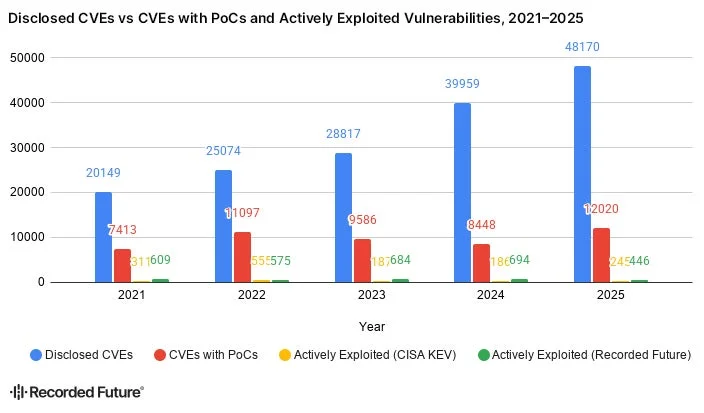
Figure 1: Yearly comparison of CVEs disclosed and those actively exploited (2021-2025)
Attackers focus on a small subset of vulnerabilities that align with certain criteria, like the potential for remote exploitation or relevance to widely-used software. The process of taking a flaw from discovery to a weaponized exploit demands time and careful targeting. Yet, for those vulnerabilities that meet the right criteria, the landscape is rapidly changing. Research suggests that as of 2025, nearly 29% of Key Exploited Vulnerabilities (KEVs) are being exploited on or before their announcement date, indicative of a rising trend in zero-day exploits.
The Impact of AI on Vulnerability Dynamics
Recent models from companies like Anthropic and OpenAI have entered the spotlight, promising enhanced cyber defense capabilities. Yet, the ability to automate vulnerability discovery using AI isn’t new. Existing models have already shown proficiency in identifying vulnerabilities and assisting in exploit development. Currently, the operational edge lies with skilled personnel who can harness these tools effectively, even as the increased velocity of discoveries adds to the mix of challenges faced by vulnerability managers.
This shift influences vulnerability management in three notable ways:
- Increased report credibility: New AI systems can assist in validating findings, enhancing the quality of reports organizations must triage.
- Accelerated exploit timelines: The capability of large-language models (LLMs) to speed up the process from discovery to exploitation is redefining how quickly vulnerabilities must be addressed.
- Cost reduction in exploit development: Emerging AI models help produce faster proofs of concept and enable skilled operators to iterate on viable exploits more efficiently.
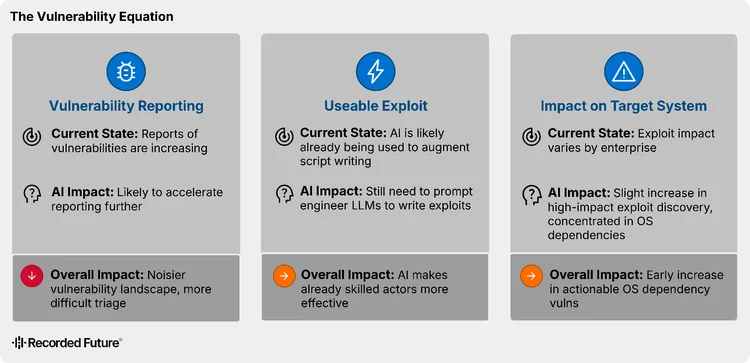
Figure 2: The vulnerability equation: Potential impacts of automated capabilities on reporting and exploit development.
The Risks of Increased Vulnerability Discovery
A surge in AI-driven vulnerability discovery is expected to lead to a broader array of reported issues. For instance, following renewed AI investments, Microsoft experienced one of its largest Patch Tuesdays, yet the majority of findings didn’t substantially elevate the realm of AI-driven discoveries. This raises a critical challenge: while more flaws will certainly be uncovered, can security teams process and prioritize them efficiently enough to act before they become exploited?
Researchers are already grappling with a backlog of vulnerability reports, making it difficult to assess overall risk and increasing uncertainty about which vulnerabilities could potentially lead to high-impact events. The volume of plausible findings will only compound these challenges, leading to a muddled prioritization landscape.
Adapting to New Threats
As the timeline shortens for responding to actual threats, defenders find themselves with diminished timeframes in which to act. Automating exploit development could accelerate the timeline from validation to weaponization for the critical vulnerabilities that matter most. Medium-severity vulnerabilities, typically ranked as non-urgent, might need reevaluation, as their role in exploit chains becomes more significant.
Strategies for Effective Vulnerability Management
Organizations must adapt their vulnerability management strategies to the realities of an AI-driven threat landscape. The key will be to distinguish between mere findings and actionable threats. Here are five strategies to consider:
1. Automate Prioritization and Response
Transition from traditional scoring to real-time risk assessments focused on exploitability. Implement automated systems for scanning and threat hunting to promptly identify active exploitation, especially in widely-used applications.
2. Accelerate Patch Management
As exploit timelines shrink, patch management must evolve. Automated patching and remedial controls are likely necessary to keep pace with AI-enhanced discoveries. Keep a human-in-the-loop for critical decisions and ensure all automated actions are thoroughly logged.
3. Minimize Legacy Software Dependence
Older, unsupported systems are increasingly at risk. It’s vital to assess the necessity of such software rigorously, making sure that any dependency is tightly controlled and isolated.
4. Emphasize Early Vulnerability Detection
Incorporating automated security testing within development can reduce the workload of remediation by catching vulnerabilities early in the software lifecycle.
5. Prepare for High-Impact Vulnerabilities
Establish response plans for critical flaws, including strategies wherein immediate patches may not be feasible. Preparation should include not just patching plans but also countermeasures like network segmentation and access control.
By refining their vulnerability management frameworks, organizations can enhance their defenses against a backdrop of evolving threats, ensuring they’re not only discovering more problems but also equipped to remediate them effectively.