Recorded Future is raising the bar with its latest feature: Automated Signature Creation, integrated into its Attack Surface Intelligence (ASI) suite. This capability is designed to enhance the pace of cybersecurity defenses in light of the growing prevalence of AI-generated exploits. The field of cybersecurity is no longer just the domain of specialists; it’s becoming a battleground where speed and agility can mean the difference between thwarting an attack and suffering a breach.
By continually mapping an organization’s external elements, ASI correlates emerging vulnerabilities with actionable threat intelligence, prioritizing responses that empower defenders to act before attacks can manifest. Recorded Future's approach is emblematic of a broader trend in cybersecurity: the shift from reactive measures to proactive strategies that anticipate threats rather than merely responding to them.
Responding to Rapid Exploit Development
The environment of cybersecurity threats is changing rapidly, with attacks becoming more sophisticated and harder to detect. The timeline for exploiting vulnerabilities has significantly shortened, creating a pressing need for security measures that can keep up. Cutting-edge AI models are now capable of discovering zero-day vulnerabilities in prevalent operating systems and web browsers, a task once reserved for elite governmental cyber units. This transformation raises serious concerns about the effectiveness of traditional security measures that simply can’t sustain a defensive posture against such an accelerated threat landscape.
A 2020 report indicated that the gap from vulnerability detection to exploitation shrank from 45 days to just 15 days within a decade. Fast forward to today, and evidence shows that weaponization can occur within mere hours of disclosure. This is alarming. Organizations that fail to adapt could find themselves at a critical disadvantage.
This demands a shift away from traditional defensive measures. It's clear that existing manual processes can’t keep pace with the speed at which threats are emerging. Reviewing the development trajectory from earlier detection methods to Recorded Future’s recent enhancements illustrates the pressing need for swift adaptation in defense strategies against AI-driven vulnerabilities. The stakes are high, and there's little room for complacency.
The Evolution of Signature Creation
Historically, Recorded Future relied on signatures crafted by experts from the Insikt Group®. While their contributions were high-quality, their manual nature limited their speed. For example, during the response to CVE-2025-0994, the Insikt Group developed a Nuclei template to help identify vulnerabilities in Trimble Cityworks. This allowed organizations to pinpoint areas needing urgent patching while actively scanning web infrastructures for threats.
Yet, given the accelerated timeline for exploitation, it’s clear that relying solely on human-generated signatures is inadequate. Cases such as the breach involving OpenAI's agents exploiting a zero-day vulnerability highlight this urgency. If organizations wait too long to apply manual fixes, they may find themselves compromised.
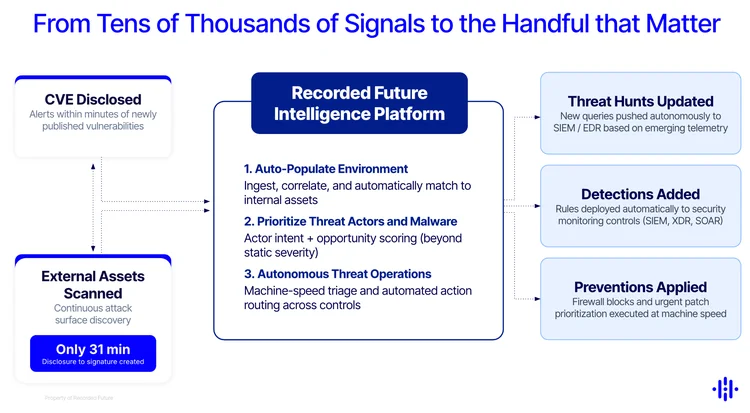
To combat the immediacy of threats, Recorded Future has automated the signature creation process. This feature efficiently converts newly discovered vulnerabilities into deployable detection signatures in as little as 31 minutes—a significant improvement that can boost the volume of real-time signatures available within their platform. Making such speed possible is crucial for organizations that need to stay a step ahead of potential attackers.
Understanding Automated Signature Creation
What does “signature” mean in this context? Essentially, it acts as a piece of detection logic tailored to assess whether specific assets are vulnerable. It changes the narrative from merely identifying assets to pinpointing which ones are at risk of compromise. This nuanced understanding of risk can be the difference between an effective patching strategy and one that leaves critical gaps open to exploitation.
The Automated Signature Creation process operates as an early warning system that follows three critical steps:
- The platform maintains a continuous overview of an organization’s online presence, including domain records and ownership information.
- Upon identifying a new vulnerability, the system cross-references it with existing assets and correlates with actual threat activities, rather than relying solely on generic risk assessments. It thoroughly assesses evidence linking the vulnerability to real-world exploits, including malware and threat actor intent.
- If deemed relevant, the Recorded Future Intelligence system autonomously generates a detection signature or fingerprint associated with the CVE, often within a remarkable timeframe of 31 minutes.
Implications for Future Cybersecurity Strategies
As cybersecurity threats continue to evolve, the push for automation in threat detection is likely to grow more pronounced. This isn't just about speed; it's also about accuracy. Automated systems can reduce the potential for human error while addressing vulnerabilities in real-time. With Recorded Future's new feature, if you're working in this space, you’ve got a tool that could reshape your approach.
The importance of swift adaptation to AI-generated exploits cannot be overstated. There’s a sense of urgency here: organizations must invest in automated solutions to ensure their defenses are aligned with the realities of modern attacks. Some might see this as a necessity of survival rather than a luxury. And yet, widespread adoption won’t happen overnight. Many organizations still rely on traditional methodologies, and transitioning to fully automated processes will require significant operational shifts and investment.
This trend towards automation represents more than just a technological upgrade; it's a response to a fundamental shift in cyber threat dynamics. This is about resilience in the face of adversity. With the stakes this high, the push for enhanced automated solutions will likely define the next chapter of cybersecurity.